
B2B Marketing Automation for Go-to-Market (GTM) Teams
.png)
.png)
Search for “B2B marketing automation” online, and you’ll mostly find content about HubSpot workflows and MailChimp email drip campaigns. That’s fine if you’re focused on inbound demand generation. But it misses the mark for GTM engineers and agency owners managing outbound efforts.
You’re not just trying to nurture leads through a funnel. You’re looking to automate prospecting across tools like Apollo and Clay, run waterfall enrichment to fill data gaps, and coordinate email and LinkedIn outreach while keeping your CRM in sync.
Most marketing platforms weren’t built for that. Over time, “B2B marketing automation” became shorthand for inbound tooling. What GTM teams need is better described as “outbound orchestration.” A system that automates the full go-to-market motion, not just what happens after someone downloads a PDF.
This article breaks down what B2B marketing automation means for GTM teams today and how to build automated revenue systems without creating more tool sprawl.
What B2B Marketing Automation Means for GTM Teams
The original idea of B2B marketing automation came from inbound teams. A lead fills out a form, gets scored, and enters a nurture sequence. Click enough links, and a rep is notified. That model works when demand comes to you, but breaks down the moment outbound becomes your main growth engine.
At outbound scale, automation stops being about message delivery. It becomes a system that decides who to contact, when to reach out, which channels to use (LinkedIn, SMS, email, etc.), and how to keep context intact as conversations move from one place to another.
In practice, GTM teams rarely focus on questions like, “Which email goes out next?” Instead, they’re asking questions like:
- “Which accounts are worth talking to right now?”
- “What signals matter more. Funding, hiring, tech changes?”
- “Do we lead with a LinkedIn connection request or a custom video email?”
- “They replied on WhatsApp, but the sales team only sees email. How do we not look like amateurs?”
This is the core of modern B2B marketing automation. It’s a system that automates the entire revenue motion, at scale. Not just nurture sequences, but everything from list building and enrichment to multi-channel outreach and pipeline tracking.
.png)
In other words, effective B2B marketing looks a lot less like traditional marketing automation and a lot more like revenue orchestration. To help put things in context, here’s a look at how both concepts compare at a glance:
Most marketing automation platforms only cover a narrow slice of the GTM motion. Usually, email and basic CRM updates. The moment you ask them to coordinate data enrichment, signals, outreach, replies, and pipeline logic, things become fragile.
That’s when tool sprawl creeps in. You get one tool for list building. Another for enrichment. Another for outreach. Another to glue it all together. Like trying to conduct an orchestra with 15 soloists who can’t read the same sheet music. That’s why it sounds like chaos.
The Tool Sprawl Problem: When Automation Becomes the Bottleneck
Most GTM teams don’t set out to build a maze of automation tools. It usually happens one subscription at a time. You buy Apollo because you need data. Then you realize the emails aren’t verified, so you add Neverbounce. Then you hear about “Waterfall Enrichment,” so you pick up Fullenrich.
Suddenly, you’re running a multi-channel play, which means you need Instantly.ai for email and Heyreach for LinkedIn. To make them talk, you spend your weekend in n8n or Make.com, trying to map JSON outputs to HubSpot properties. You’re proud of it, and you should be. It’s a technical feat.
But let’s talk about what that setup costs you beyond the 12 subscription receipts. This is the silent tax on your entire operation, and it’s paid daily in three currencies.
1. The Context Tax
When your tools don’t share a brain, your system eventually hits a snag. You’ve seen examples of it play out in the wild: a prospect replies to your cold email on Tuesday, but because your LinkedIn tool doesn’t “know” that, it sends them an automated LinkedIn DM on Wednesday.
It’s embarrassing and hurts your reputation. When data is scattered across five different dashboards, your team loses the “story” of the lead. You find yourself asking, “Who talked to this person last, and what was the outcome?” while digging through three different browser tabs.
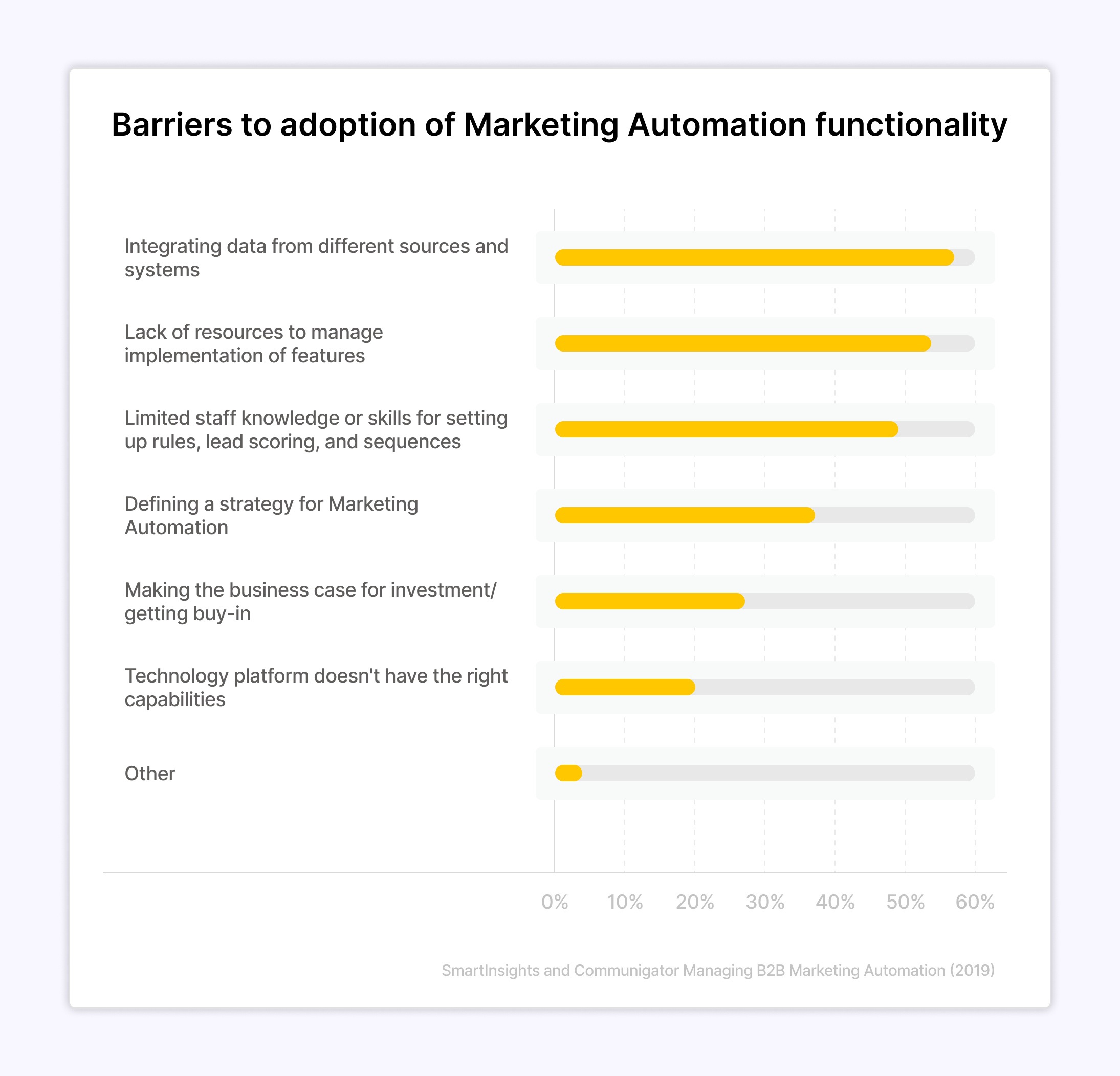
Put simply, integrating relevant data from various sources becomes a headache. Case in point, in one study from SmartInsights and Communigator, 56% of respondents cited integrating data across systems as the top barrier to adopting marketing automation software:
2. The Fragility Tax
Duct-taping 10+ tools together with Zapier or n8n feels like a superpower until something breaks. And something always breaks. Chances are, a webhook will fail, or a credit limit will be hit on one of your providers.
And because these workflows are linear, one broken link stops the entire revenue engine. You’re constantly getting n8n or make.com error notifications, and each time you fix one unexpected error, another pops up a day later.
Debugging becomes a nightmare because you have to check every single connection point to find the leak. To get the full picture, you’re manually aggregating three dashboards into a spreadsheet. For agency owners with multiple clients, this reporting mess consumes entire days.
3. The Economic Tax
The literal cost of these subscriptions is the least of your worries, though paying for 12+ tools certainly eats into your margins. The real cost is the “cognitive load.”
For an agency owner, every new tool in the stack is another thing your team has to master. It’s another point of failure and another platform to train new hires on. You end up spending more time managing the “how” of your operations than the “who” and the “why.”
Most teams try to solve this by adding more automation tools like Zapier, make.com, and n8n. But that’s just a band-aid on a broken leg. You are still paying for all the subscriptions, and you are still the one who has to fix the duct tape when it peels off.
What Effective B2B Marketing Automation Looks Like for GTM Teams
To move toward GTM excellence, your system needs to handle four specific functions on autopilot.
Lead Discovery & Prioritization
This isn’t downloading a list from Apollo once a month and calling it a day. Modern automation uses signal-based prospecting to identify targets based on ICP and buying intent continuously.
Think of it as your system reading the news for you. It watches for changes that matter, like new funding rounds, senior hires, tech stack shifts, and other buying intent signals. When it sees a trigger, it auto-enriches the account, scores it against your ideal customer profile, and automatically pulls it into your workflow.
For example, a “50-200 person FinTech company that just raised $15M and uses Salesforce” becomes a high-priority lead while a “5,000-person manufacturing firm” is deprioritized.
Continuous Enrichment That Keeps Data Fresh
Good automation should build a complete, verified profile before a human gets involved. That means waterfall enrichment needs to be baked directly into the workflow.
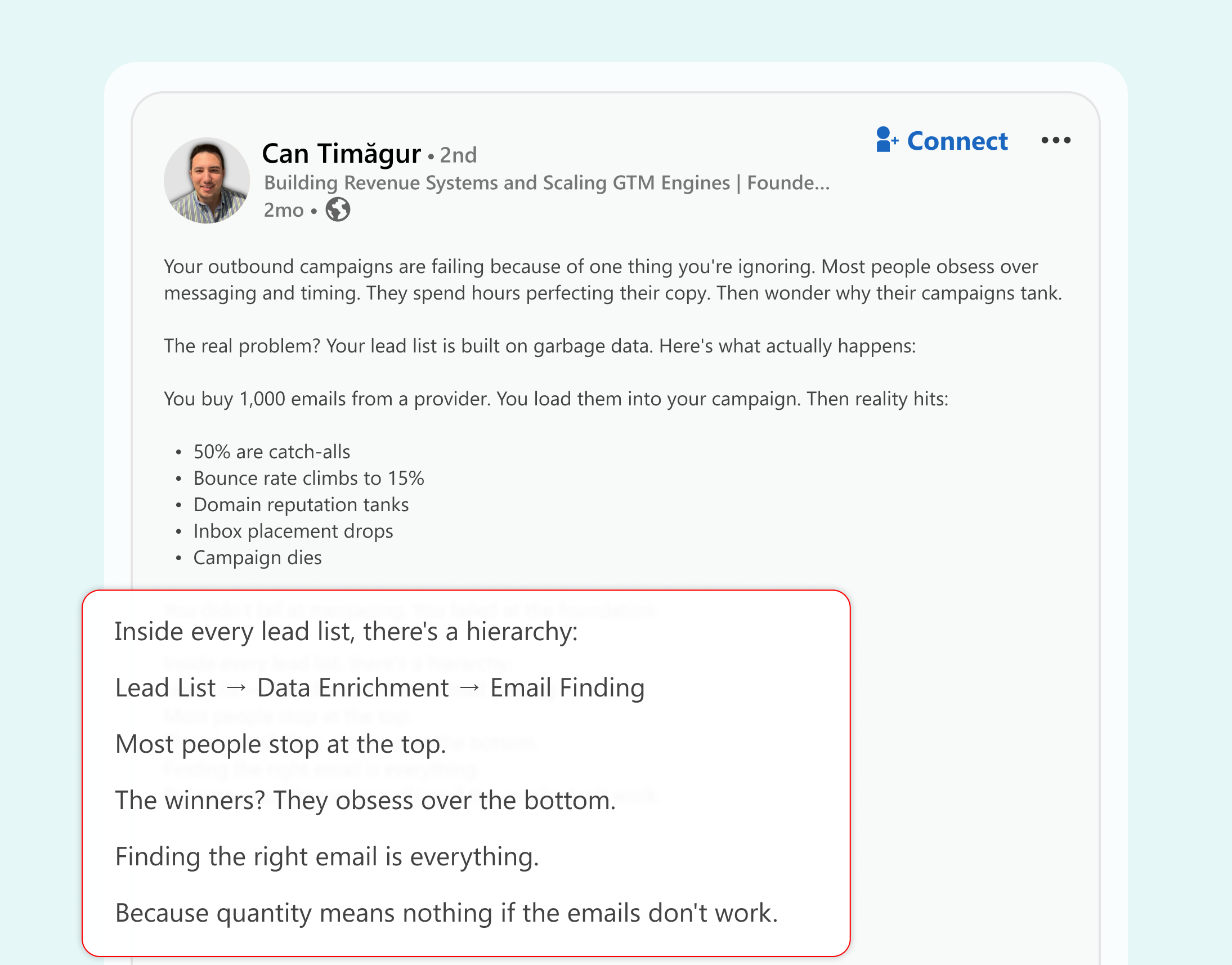
Here’s how it works. Your system identifies a target company but needs the VP of Marketing’s email address. It first queries its primary source. If that returns nothing or bounces, it automatically tries the second-best source, then the third.
Once found, the system validates the data, updates the CRM, and only then triggers outreach. This serves to keep your find rate as high as possible while keeping your bounce rate low. Can Timağur, a top GTM engineer, offer a great breakdown of how this often plays out:
And because enrichment is continuous, the data stays fresh. Someone changes jobs? Their email gets updated. A company gets acquired? The parent company data gets added.
Coordinated Multi-Channel Execution
This is where most outreach tools out there fall short. Effective automation orchestrates conversations using conditional flow, such as:
- A personalized LinkedIn connection request mentioning a shared connection or a recent post.
- If the connection is accepted, the system waits 48 hours, then sends a tailored AI voice note.
- If there’s no response, it triggers a personalized email on day 5 with a custom landing page link.
The intelligence is in the logic gates. If the prospect replies “not interested” on WhatsApp, the sequence stops instantly across all channels to avoid the fatal error of following up after someone already said no. Your sales rep simply gets a notification with full context.
Unified Inbox & Reply Management
Every reply from every channel (LinkedIn, email, WhatsApp, SMS) flows cleanly in one place. What’s more, an auto-classification feature sorts replies into predefined buckets like “interested,” “not interested,” “out of office,” and “requesting more info.”
In other words, you preserve context across channels. If a prospect replies on LinkedIn while your rep is looking at the email inbox, the system fires a notification. The rep sees the full conversation history across both channels.
Pipeline Tracking & Feedback Loops
Stage progression happens automatically based on engagement. This is where most automation falls apart. Traditional marketing platforms push data in one direction: from marketing to sales.
In contrast, GTM orchestration creates feedback loops where CRM data flows back to inform list building and targeting. If, for instance, prospects who engage with LinkedIn voice notes book meetings at 2X the rate of email-only sequences, the system learns and shifts more outreach to voice notes.
Revenue attribution across channels also becomes more efficient when everything lives in one system. You can accurately answer “which channel works best for us?” because the data isn’t fragmented across five different tools.
Conigma: One Platform for Your Entire GTM Motion
Most of the problems covered above come down to fragmentation. Too many tools, and not enough shared context across the GTM motion.
We built Conigma because we were running into the same problems. It’s a no-code, AI-powered platform where list building, waterfall enrichment, and multi-channel outreach (LinkedIn, email, WhatsApp, and SMS) live under one roof.
You also get a unified inbox so you never lose context, and a built-in CRM that actually knows what your outreach tools are doing. Everything runs in one place, with unified visibility across accounts and channels.
What’s more, you can keep your current stack while we become its central nervous system. So if you’re already an Apollo or Heyreach power user, you can plug them directly into Conigma. And if you’d like to run Conigma natively to cut down on subscriptions, you can do that, too.
Conigma is built for the agency owners tired of juggling 10+ different client dashboards, and the GTM engineers who want to build revenue systems that don’t break every time an API updates. One control room means no more context switching, no broken integrations, and no taxes on your growth.
A More Sustainable Way to Automate B2B Marketing
Automation is often sold as a way to do more. But for modern GTM teams, that’s the wrong goal. True automation is about running a cleaner, more controllable system.
It’s the confidence of a system that works without you babysitting it. When a deal closes, you can trace it back to the exact touches that mattered and use that signal to repeat the outcome.
That’s the thinking behind Conigma. It’s built for agency owners scaling across dozens of campaigns and GTM engineers designing complex outbound systems. Everything runs in one place, with shared context and clear visibility.
We also started a GTM community for GTM leaders who share their latest playbooks and strategies daily. We’d love to have you join the conversation.


